
Back when building meant muscle, intuition, and a few rough sketches on paper there were no calculators, no software, and certainly no digital blueprints. Builders relied on gut instinct and experience passed down through generations.
Fast forward to today, and things couldn’t be more different. Homeowners and contractors now depend on precision, technology, and regional cost data to plan their residential projects. Whether you’re building a new home in Texas, renovating a property in California, or adding a garage in Georgia, knowing your residential construction cost per square foot by zip code can mean the difference between staying on budget and facing painful overruns. Modern construction doesn’t forgive guesses; it rewards those who estimate smartly. That’s where a residential construction cost per square foot by zip code calculator becomes your best budgeting ally.
Understanding the Role of Zip Code Calculators in Modern Estimating
The residential construction cost per square foot by zip code calculator isn’t just another online tool, it’s the bridge between broad averages and real, local data.
These calculators pull in regional material prices, labor rates, and economic trends to give an accurate reflection of what your project will cost in your area. That means a 2,000 sq. ft. house in Arizona may cost far less than the same design in New York even with identical materials.Here’s an example comparison:
| Location | Average Residential Cost/Sq. Ft. | Estimated 2,000 Sq. Ft. Project Cost |
| Texas | $130 – $180 | $260,000 – $360,000 |
| California | $250 – $350 | $500,000 – $700,000 |
| Florida | $160 – $210 | $320,000 – $420,000 |
| Georgia | $140 – $190 | $280,000 – $380,000 |
| Michigan | $150 – $200 | $300,000 – $400,000 |
Costs based on averages compiled from regional estimating data.By combining such data with insights from professional estimators like Rassai Building Service, you get a true-to-life projection of your construction budget.
How the Residential Construction Cost Calculator Works
The logic behind these calculators is straightforward but powerful. They gather and process local data to determine:
| Input | Description |
| Zip Code | Define your labor and material market rates. |
| Project Type | New build, remodel, addition, or renovation. |
| Square Footage | Core measure to calculate baseline cost. |
| Material Quality | Standard, mid-range, or premium finishes. |
| Labor Complexity | Based on design, MEP intensity, and structural needs. |
The result: a detailed cost breakdown showing base construction, finishes, mechanical systems, and local adjustments. However, as any experienced estimator knows, even the most advanced calculator is only as good as the data you input. That’s why pairing it with professional residential estimating services like those offered by Rassai Building Service ensures true accuracy.
Key Industries That Shape Residential Construction Costs
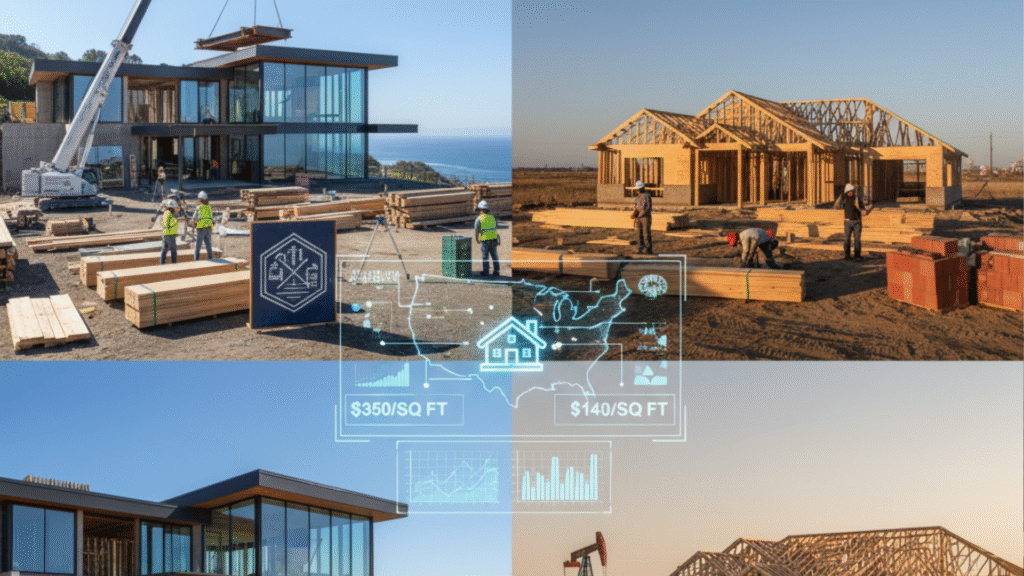
When using a residential construction cost per square foot by zip code calculator, it’s vital to understand what industries actually drive those costs. Each sector contributes differently to material, labor, and overhead pricing across your zip code.
| Industry Category | Key Roles in Residential Construction | Impact on Project Cost |
| Construction Industry | General Contractors, Subcontractors, and Specialty Trades (Electrical, Plumbing, HVAC, Roofing, Masonry, Painting). | Direct labor and installation costs; often 40–50% of the total project. |
| Construction Materials Industry | Suppliers of Cement, Concrete, Steel, Lumber, Bricks, Glass, and Tiles. | Material quality and availability heavily affect per-square-foot cost. |
| Professional Services Industry | Architects, Structural Engineers, Civil Engineers, and Surveyors. | Design complexity and compliance fees; typically 5–10% of total budget. |
| Real Estate & Finance Industry | Developers, Banks, Mortgage Institutions, and Real Estate Agents. | Land acquisition, permits, insurance, and financing impact. |
| Machinery & Equipment Industry | Heavy machinery suppliers, rental companies, and power tool providers. | Site prep, excavation, and equipment rental fees; around 3–5% of cost. |
This table demonstrates how your zip code calculator indirectly factors in these industries. For instance, in high-demand areas like California or Florida, both material and trade labor from these sectors are priced at a premium which explains why per-square-foot rates vary significantly from one region to another.
Why Cost Per Square Foot Varies So Much Across the U.S.
Every city, every region, even every zip code comes with its own cost behavior. Here’s why:
| Factor | Impact on Cost | Example |
| Labor Rates | Higher in urban areas. | San Francisco vs. Dallas. |
| Material Transport | Costlier in remote regions. | Rural Minnesota lumber costs. |
| Building Codes | Stricter codes raise costs. | California seismic codes. |
| Weather Conditions | Harsh climates require stronger materials. | Florida hurricane zones. |
| Local Taxes & Permits | Directly increase per-square-foot costs. | Chicago vs. Atlanta permits. |
So, when you use a zip code-based calculator, it automatically factors these regional variables into your project cost.
From Digital Tools to Professional Accuracy
While calculators give an excellent starting point, residential construction estimating services ensure accuracy that online tools can’t match.At Rassai Building Service, professional estimators analyze detailed architectural drawings, labor market data, and supply-chain variations to build a cost model that truly reflects your location.
This process uses specialized residential estimating software integrated with 5D BIM (Building Information Modeling) giving you a comprehensive financial snapshot of your project.
| Estimation Tool | Purpose | Accuracy Range |
| Zip Code Calculator | Rough planning | ±15% |
| Residential Estimating Software | Detailed breakdown | ±5% |
| Full Professional Estimate (Rassai) | Bid-ready costing | ±2% |
Key Cost Elements Every Homeowner Should Consider
When using a cost-per-square-foot calculator, understanding where your money goes helps avoid surprises.Here’s a typical residential cost composition:
| Cost Component | Average % of Total Cost |
| Site Work & Permits | 5–10% |
| Foundation | 10–15% |
| Framing | 15–20% |
| Roofing | 5–10% |
| Interior Finishes | 25–35% |
| Mechanical Systems (HVAC, Electrical, Plumbing) | 15–25% |
| Miscellaneous & Contingency | 5–10% |
For example, if your total project cost is $400,000, your mechanical systems alone could account for up to $100,000. That’s why using specialized residential estimating services California or Texas can make or break your budget.
Real-World Example: A Tale of Two Projects
The homeowner in Florida planned a 2,500 sq. ft. custom home. Using a basic online calculator, they estimated $400,000.However, when Rassai Building Service reviewed the same project, the final estimate came to $460,000 due to additional hurricane-rated roofing, wind bracing, and upgraded HVAC required by Florida building codes.
That $60,000 difference could have caused major financial stress but professional review caught it early.In contrast, a homeowner in Texas building a similar structure might spend $370,000 because of lower labor and code requirements.
How to Use a Zip Code Calculator the Right Way
To get accurate numbers, follow this expert approach:
| Step | Action | Purpose |
| 1 | Input your exact zip code | Ensures localized pricing. |
| 2 | Select accurate project type | Remodel vs. new build changes costs. |
| 3 | Choose realistic material quality | Avoid underestimating premium finishes. |
| 4 | Compare calculator results with local estimators | Validates assumptions. |
| 5 | Refine using Construction Estimating Services | Converts estimates into real budgets. |
Technology’s Role in Modern Residential Estimating
Modern estimating tools are changing the way projects are planned.
Key Tools Used by Estimators:
| Software | Function | Benefit |
| PlanSwift | Digital takeoff | Fast and visual estimation |
| Bluebeam | Markup and QTO | Reduces manual errors |
| CostWorks | Database-driven pricing | Region-based accuracy |
| ProEst | Cloud-based collaboration | Real-time data sharing |
| Custom Rassai Models | Proprietary local data | Highly accurate for U.S. states |
Integrating these tools with residential cost per square foot calculators ensures every nail, beam, and screw is accounted for reducing surprises and saving thousands.
Common Mistakes Homeowners Make When Budgeting
Even with calculators and expert estimators, common budgeting pitfalls persist:
| Mistake | Consequence |
| Ignoring local permit costs | Unexpected fees mid-project |
| Using outdated data | Underestimated material costs |
| Assuming DIY savings | Unaccounted labor delays |
| Skipping professional review | Risk of 10–20% cost overruns |
By partnering with experts like Rassai Building Service, these costly mistakes can be avoided.
Why Partnering with Rassai Building Service Is a Smart Move
When precision meets experience, results speak for themselves.Rassai Building Service combines digital estimating tools with years of on-site construction experience providing residential and commercial estimating services that are trusted across the USA.
Their estimators understand regional variations, seasonal labor shifts, and supplier dynamics that even advanced calculators can’t fully capture.If you’re planning your next project in California, Texas, Florida, or nearby Pearl states, you can even check your location directly through this Google Maps link to confirm service availability.
Frequently Asked Questions
What Is the Most Accurate Way to Estimate Residential Construction Costs?
The best way is to use a zip code-based calculator for preliminary numbers, then refine your results with professional estimators from Rassai Building Service.
How Much Does It Cost to Build a Home Per Square Foot in the USA?
On average, residential construction costs range from $150 to $350 per sq. ft., depending on location, design complexity, and finishes.
Why Does Zip Code Affect Construction Cost?
Local labor rates, taxes, permits, and supply costs vary by region. The calculator adjusts based on your zip code to reflect true local conditions.
Are Residential Estimating Services Worth It?
Yes professional services reduce error margins from ±15% to ±2%, potentially saving tens of thousands of dollars on your total build.
Can I Use This Calculator for Remodeling or Additions?
Absolutely. Most residential estimating software allows users to select project type, whether new builds, renovations, or home additions.