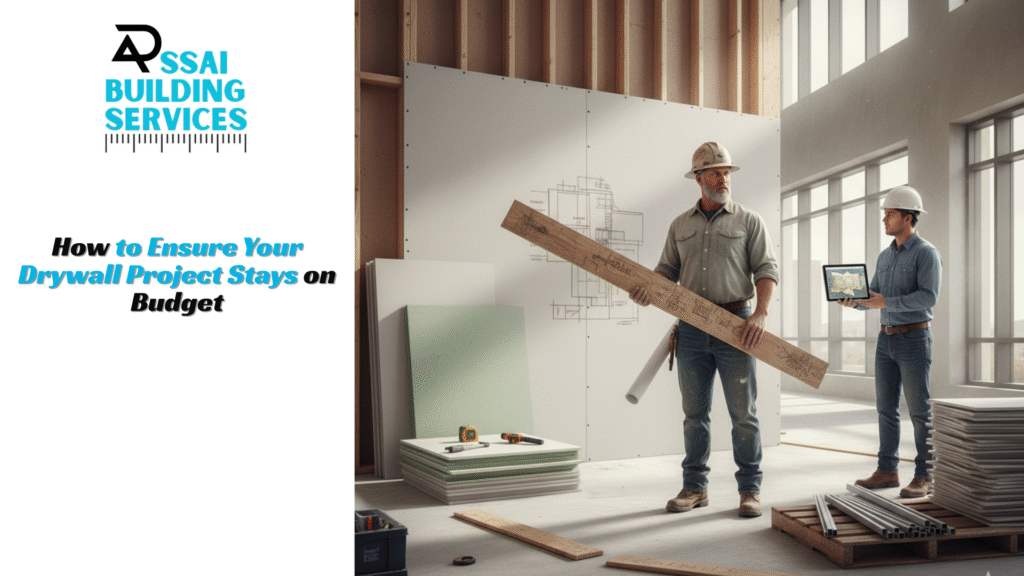
Back when building meant muscle, dust, and a good dose of guesswork, drywall estimation was as simple as “eyeballing the wall.” Contractors measured by feel, scribbled notes on wood planks, and trusted experience more than numbers. It worked sometimes. But as buildings grew taller, codes grew stricter, and clients demanded precision, that old method started to fall apart.
I still remember a hospital project years ago in Texas where the drywall cost jumped 30% mid-construction. Why? The estimator had skipped moisture-resistant boards for patient bathrooms, underestimated ceiling sheets, and forgot corner bead quantities. The mistake cost thousands and a few sleepless nights.
Today, that kind of error is no longer an option. Projects move fast, budgets are tight, and accuracy is everything. That’s where drywall takeoff services and modern construction cost estimation services step in not just to count sheets but to control chaos.
The True Cost Components of a Drywall Project
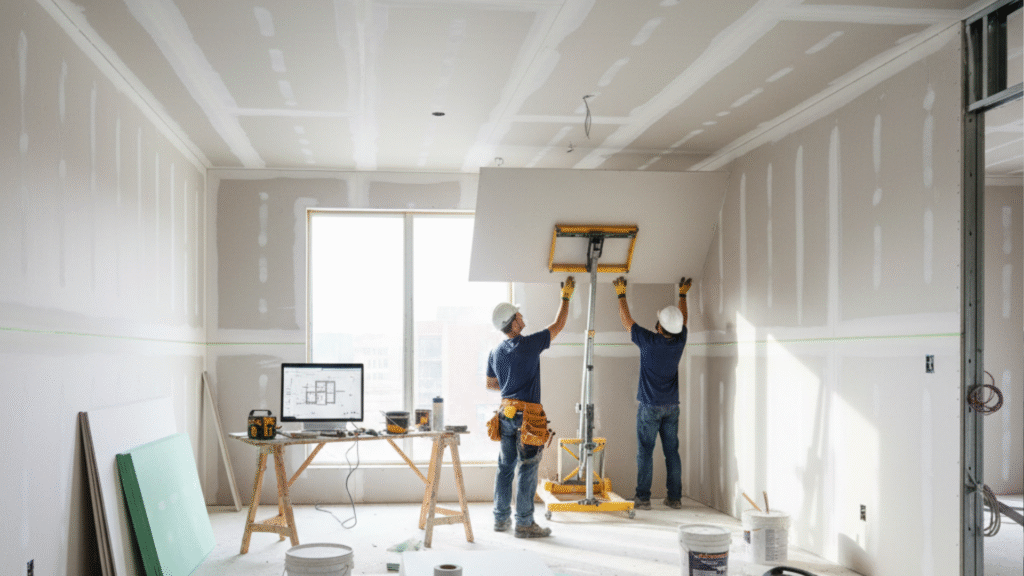
To keep any drywall project on budget, you must first understand every cost element. It’s not just drywall sheets it’s screws, tape, joint compound, labor, lifts, and finishes.
| Drywall Cost Components | Description | Estimated Range (USD) |
| Drywall Sheets (4×8 ft) | Standard gypsum panels for walls & ceilings | $12 – $20 each |
| Moisture-Resistant Boards | For bathrooms, kitchens, or medical rooms | $18 – $28 each |
| Joint Compound | Used for seams and finishing | $8 – $12 per bucket |
| Screws & Fasteners | Galvanized drywall screws | $30 – $60 per 1,000 pcs |
| Labor (Installation) | Cost to hang, tape, and finish | $1.50 – $2.50 per sq. ft |
| Finishing & Sanding | Includes texture or paint prep | $0.40 – $0.80 per sq. ft |
A simple 4,000 sq. ft residential project can run anywhere between $9,000 and $15,000, depending on materials and labor rates. Using a drywall takeoff service helps identify exactly where each dollar goes before construction begins.
Why Drywall Takeoff Services Are Your Budget’s Best Friend
Drywall takeoffs do far more than counting boards. They prevent cost overruns and ensure every screw, corner bead, and sheet is included. A professional Rassai Building Service estimator reviews blueprints, measures digital drawings, and produces accurate material quantity reports tied directly to current market prices.
| Takeoff Advantage | Impact on Project |
| Digital quantity extraction | Reduces manual measuring errors |
| Real-time pricing updates | Reflects true material market rates |
| Waste factor calculation | Prevents shortages during installation |
| Labor productivity benchmarking | Estimates labor hours accurately |
| Clear reporting for procurement | Helps order exact quantities |
This level of control helps contractors avoid surprises, meet deadlines, and keep profit margins intact.
How to Do a Drywall Takeoff the Right Way
Even experienced estimators sometimes misjudge drywall quantities because they miss small details like soffits, ceiling recesses, or double-layered walls. A proper drywall takeoff includes a clear step-by-step calculation process.
| Stage | What to Measure or Include | Pro Estimator Tip |
| 1. Wall Area | Measure wall height × length for all rooms | Deduct openings (windows, doors) |
| 2. Ceiling Area | Include flat, vaulted, or drop ceilings | Add 10% waste for angled cuts |
| 3. Corners & Beads | Count linear footage for corners | Always order 5% extra |
| 4. Fasteners | 32 screws per 4×8 sheet (approx.) | Order per 1,000-piece boxes |
| 5. Joint Compound | One 5-gal bucket covers 400 sq. ft | Round up for multi-coat finishes |
| 6. Labor | Use local productivity data | Adjust for ceiling height & complexity |
For most projects, a Construction Cost Estimation Service ensures these takeoffs are integrated with real-time pricing databases giving you budget confidence before you ever hang the first sheet.
The Role of Technology From Drywall Takeoff Software to Real-Time Cost Updates
Modern drywall takeoff software like Bluebeam, PlanSwift, or Autodesk Quantity Takeoff allows estimators to measure directly from digital blueprints. When linked with Construction Estimating Services, these tools turn a two-day manual process into an accurate two-hour workflow.
| Technology | Purpose | How It Saves Money |
| Takeoff Software | Automates measuring from drawings | Reduces man-hours by 60% – 80% |
| Cloud-Based Databases | Syncs national material prices | Keeps estimates aligned with current markets |
| BIM Integration | Connects 3D design to quantity | Detects conflicts early |
| 5D Estimating | Adds time and cost layers | Prevents schedule-cost clashes |
This digital transformation means fewer reworks, faster approvals, and tighter cost control.
State-Wise Expertise: California, Texas, Florida, and Georgia
Regional construction costs vary dramatically, especially for drywall materials and labor. A local understanding makes or breaks your estimate.
| State | Avg. Drywall Cost (per sq. ft) | Key Local Factor |
| California | $2.20 – $3.10 | High labor + seismic construction standards |
| Texas | $1.60 – $2.30 | Moderate pricing, large crews available |
| Florida | $1.80 – $2.50 | Moisture-resistant drywall mandatory |
| Georgia | $1.50 – $2.10 | Affordable labor markets |
At Rassai Building Service, our drywall takeoff services are tailored by region. Whether it’s California, Texas, or Florida, we adjust cost databases to local pricing and code requirements because one estimate does not fit all.
Common Mistakes That Blow Drywall Budgets (and How to Avoid Them)
| Mistake | Impact on Budget | Expert Solution |
| Ignoring Ceiling Variations | Underestimation of 8% – 15% | Always separate wall vs ceiling quantities |
| Skipping Moisture-Resistant Boards | Rework in wet areas | Use green or purple board where required |
| Not Counting Door/Window Returns | Shortage of materials | Include return wall segments |
| Overlooking Waste Factors | Additional site purchases | Add 10% standard waste |
| Ignoring Local Code Specs | Failed inspections | Reference local building codes in estimate |
Each of these issues might seem minor but can add thousands to your drywall budget.
How Rassai Building Service Keeps Projects Accurate and Profitable
Rassai Building Service has become a trusted name for construction cost estimation and drywall takeoff services across U.S. states. Our approach is built on precision, transparency, and decades of real-world field knowledge.
| Service Feature | Value to Client |
| Dedicated Drywall Estimators | Specialists trained for residential & commercial jobs |
| Cloud-Integrated Reporting | Share live estimates with your project team |
| Regional Pricing Libraries | Adjusted by state and market conditions |
| Quality Control Review | Every takeoff checked by senior estimator |
| Time-Saving Automation | 80% faster than manual estimating |
By combining human expertise with digital precision, we help builders, developers, and contractors protect their budgets and their reputation.
Frequently Asked Questions
How do I calculate the cost of drywall per square foot?
Divide the total project area by material and labor rates. For example, a 4,000 sq. ft project at $2.20 per sq. ft costs roughly $8,800.
What is included in a drywall takeoff service?
It includes quantities for drywall sheets, screws, joint compound, fasteners, beads, and labor productivity data for precise cost forecasting.
How can drywall takeoff software improve accuracy?
It eliminates manual measuring errors, calculates wall openings automatically, and provides instant updates when design drawings change.
What’s the best way to estimate drywall for large projects?
Use professional quantity takeoff services that combine digital tools with regional pricing data for large-scale accuracy.
How do regional costs affect drywall budgeting?
Material and labor costs vary widely by state. California tends to be highest, while Georgia remains among the most affordable.