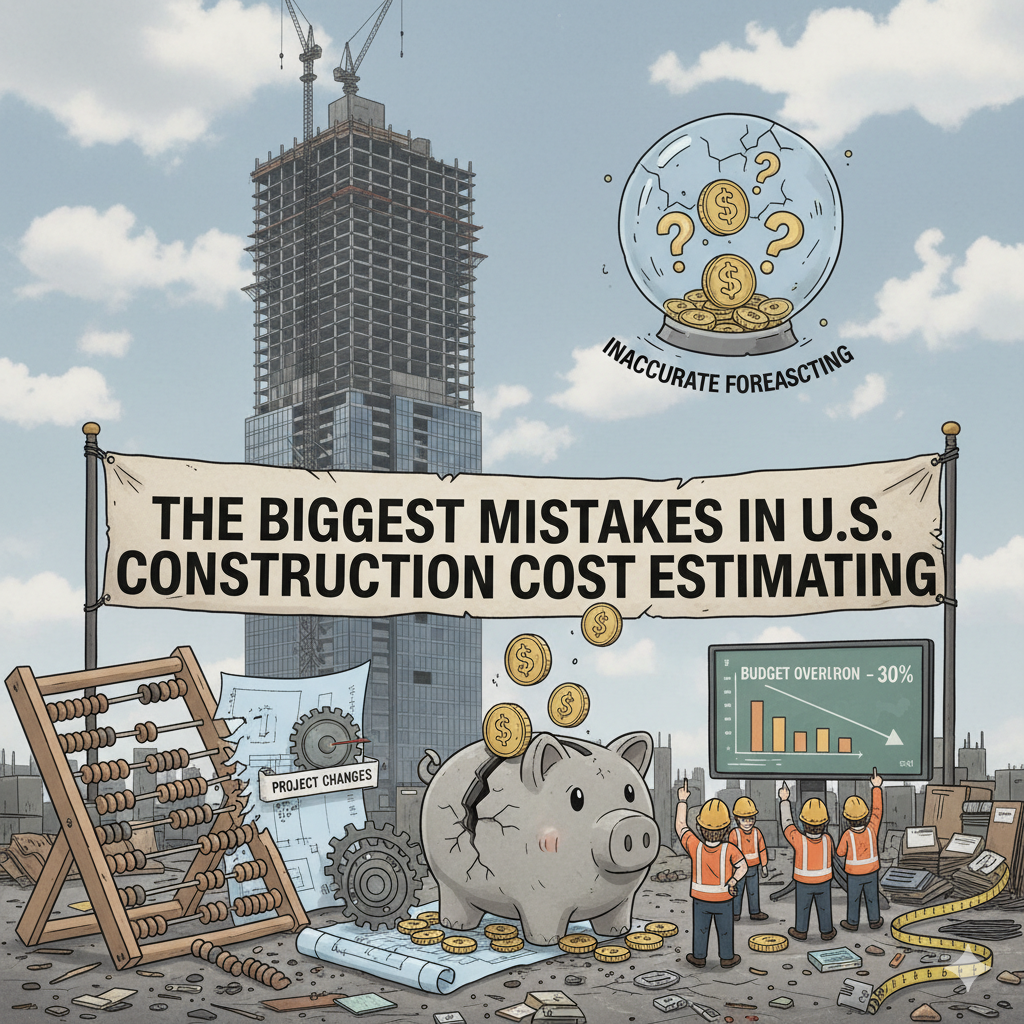
From the steel bridges of the early 1900s to today’s smart cities, construction in the United States has always depended on accurate cost forecasting. If numbers are wrong, even the most well-designed project can collapse under financial strain. In the early days, builders often relied on rough sketches and ballpark estimates methods that frequently led to disputes, unfinished structures, and unexpected losses.
Today, the U.S. construction industry works with advanced software, digital drawings, and detailed market databases. Yet, despite these tools, mistakes still happen sometimes costing millions. That is why specialized firms like Rassai Building Services provide expert construction estimating services, helping owners, contractors, and developers avoid the pitfalls that continue to challenge projects nationwide.
Let’s explore the biggest mistakes in U.S. cost estimating, why they occur, and how to prevent them.
Mistake #1: Using Outdated Pricing Data
In 2021, U.S. lumber prices skyrocketed more than 200% within a year. Contractors who based their budgets on “last year’s prices” faced financial disaster. This problem isn’t new decades ago, steel mills closing in the Midwest caused similar spikes.
Why It Happens: Some estimators rely on static cost books or recycled spreadsheets. These may be months old, but in today’s volatile market, even a few weeks can change numbers drastically.
How to Avoid It: Professional estimators track regional and real-time data. At Rassai, every estimate reflects current supplier quotes, RSMeans indexes, and labor productivity benchmarks ensuring numbers are grounded in today’s reality, not yesterday’s assumptions.
Mistake #2: Incomplete Quantity Takeoffs
Imagine a high-rise project in Chicago where the drywall takeoff misses 15% of partition walls. The budget looks lean at first, but once construction begins, costs spiral. This exact scenario has bankrupted contractors in the past.
Why It Happens: Manual takeoffs are prone to human error, especially under tight deadlines. Even small miscounts like missing doors, fixtures, or reinforcement bars add up to thousands of dollars.
How to Avoid It: Accurate quantity takeoffs are the backbone of reliable estimates. Our team uses digital takeoff software combined with cross-check reviews, ensuring that every square foot, cubic yard, and ton of material is correctly captured before costs are applied.
Mistake #3: Ignoring Local Labor Realities
Labor is not the same across the U.S. A carpenter in Dallas might earn half of what a union carpenter in New York City makes. Contractors who apply “average labor rates” without considering local conditions often underbid—and lose money.
Why It Happens: Many firms rely on generic labor tables or national averages, missing productivity factors like union rules, climate impacts, or project complexity.
How to Avoid It: True accuracy comes from regional expertise. At Rassai, we calibrate every estimate to reflect local wage agreements, labor availability, and productivity levels whether it’s a hospital in Boston or a distribution center in Phoenix.
Mistake #4: Rushing Estimates to Meet Deadlines
Bidding windows in U.S. construction are short, often just a few days. Contractors under pressure sometimes produce rushed estimates, skipping checks or overlooking scope details. In one school project in Florida, a rushed bid missed mechanical system costs, forcing the contractor to cover a six-figure loss.
Why It Happens: Tight schedules combined with limited staff push teams to submit “good enough” numbers.
How to Avoid It: Speed should never mean shortcuts. At Rassai, our systems are built for fast yet comprehensive estimating, balancing quick turnaround with complete accuracy—so our clients stay competitive without exposing themselves to unnecessary risk.
Mistake #5: Forgetting Risk and Contingency
Every project carries uncertainty: hurricanes in the Gulf Coast, winter delays in Minnesota, supply chain disruptions worldwide. Contractors who fail to add risk allowances often watch profits evaporate when the unexpected happens.
Why It Happens: Some estimators focus only on drawings and specifications, forgetting the bigger picture of construction risk.
How to Avoid It: Professional estimates include contingency and escalation factors, based on historical data and market analysis. At Rassai, we calculate risks proactively, so budgets remain realistic even when challenges arise.
Mistake #6: Relying on Software Alone
Digital tools like Bluebeam and PlanSwift are invaluable, but they are only as good as the estimator using them. A program can count walls or fixtures, but it cannot judge whether a design detail will actually work in the field.
Why It Happens: Some firms treat estimating as a purely digital task, forgetting the importance of human judgment and construction experience.
How to Avoid It: At Rassai, software supports our process but expert oversight defines it. Our estimators bring decades of U.S. construction experience, reviewing every output to ensure it matches real-world buildability.
Mistake #7: Failing to Update Estimates with Design Changes
Design is not static. Architects revise drawings, owners add features, and engineers adjust specifications. If estimates are not updated at each stage, budgets quickly lose accuracy. In the 2000s, several public infrastructure projects in California suffered billions in overruns due to “frozen” early budgets that never evolved with the design.
Why It Happens: Contractors often prepare a single early estimate and use it throughout, without continuous refinement.
How to Avoid It: Rassai provides progressive estimating services, updating numbers at concept, schematic, and final design stages. This ensures budgets remain aligned with evolving project realities.
Why Rassai Building Services Avoids These Mistakes
Every mistake listed above is avoidable with the right systems, tools, and expertise. At Rassai Building Services, we deliver construction estimating services that combine:
- Historical knowledge from decades of U.S. projects
- Advanced software workflows for precision and speed
- Real market intelligence from suppliers and subcontractors
- A culture of quality control that eliminates rushed or incomplete estimates
By avoiding the pitfalls that trap others, we provide clients with estimates that are not just numbers—but financial strategies that protect investments and improve project outcomes.
FAQs on Cost Estimating Mistakes
What is the most expensive mistake in cost estimating?
Using outdated material or labor prices. Even a 5% error in steel or concrete costs can add hundreds of thousands to a project.
How do quantity takeoffs impact budgets?
They are the foundation of estimating. Inaccurate takeoffs mean inaccurate budgets—causing overruns, disputes, and financial strain.
Why do contractors outsource estimating?
To save time, reduce overhead, and gain access to expert estimators who avoid common mistakes and deliver reliable numbers.
How accurate are professional estimates?
Expert-prepared estimates, grounded in current data and experience, are typically within 1–3% of final construction costs.
How does Rassai Building Services ensure mistake-free estimating?
By combining modern tools with expert oversight, we deliver fast, accurate, and affordable estimates that reflect U.S. market conditions.